
Bisbee: Photography, Extraction, and the Perfect Anthropocene Community
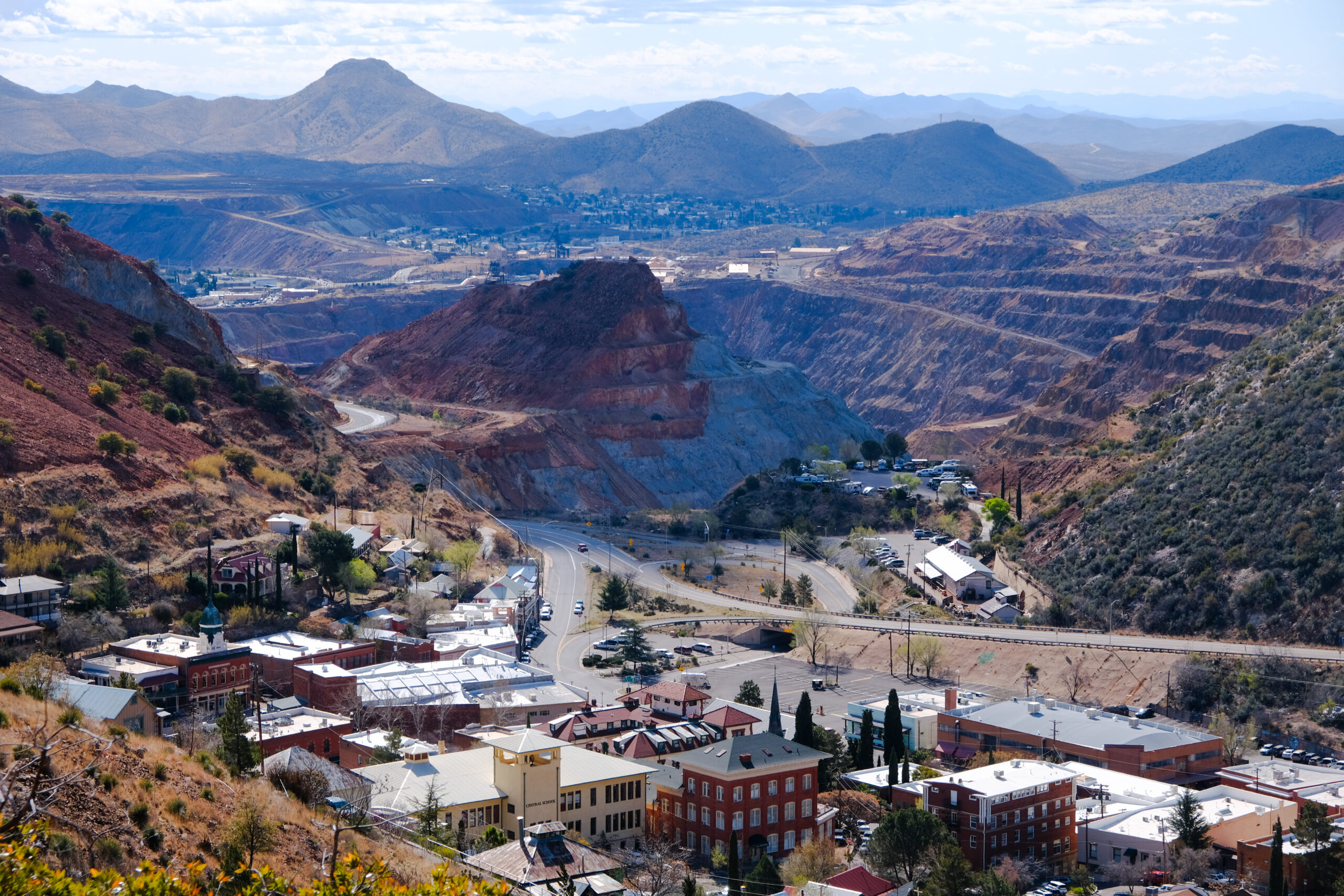
The town is a wound that has decided to become a mirror. Bisbee, Arizona — clinging to the walls of a canyon it did not choose, looking down into a pit it absolutely did choose — is the most photographed small town in the American Southwest not because it is beautiful, though it is, but because it is legible. The Anthropocene, that epoch of human inscription upon geological time, requires a text. Bisbee is that text. As a photographer I come here the way antibodies come to an antigen: compelled, purposeful, slightly frantic, unsure whether I am healing something or consuming it.
GEOLOGY AS AUTOBIOGRAPHY – The Lavender Pit Considers Its Own Reflection
Stand at the rim of the Lavender Pit — a terraced excavation one mile wide and three hundred meters deep, blasted from the earth over five decades of copper extraction — and you understand immediately why photographers like myself cannot stop pointing their lenses into it. The pit is not merely a landscape feature. It is an index of human appetite made permanent, a geological confession cut in concentric rings of mauve and ochre and sulfurous green. Each terrace represents a year, a decision, a quarterly earnings report. The pit is capitalism’s core sample.
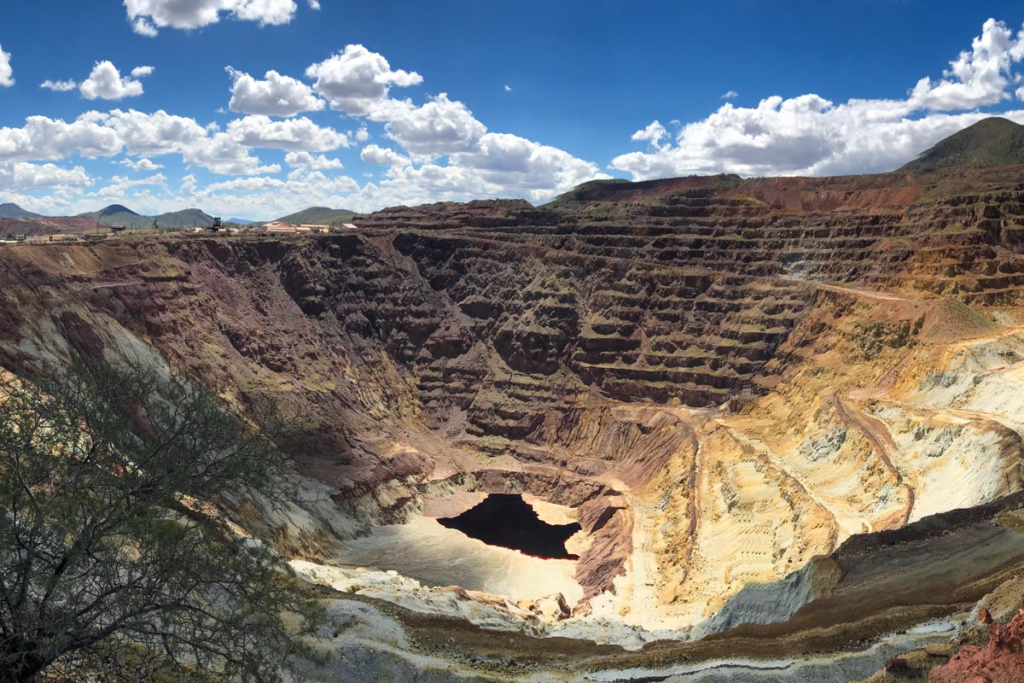
The Lavender Pit serves as the community’s iris—a monumental negative carved into the earth, where the sky is reflected in the iridescent, toxic pools of a defunct corporate dream. Here, photography ceases to be an act of art and becomes a diagnostic tool, measuring the half-life of our own civilization.
The Lavender Pit’s geometry is not natural but it has become, through time and weather and the slow oxidation of exposed minerals, something that feels more ancient than nature. It has achieved a kind of retroactive geology. The camera sensor registers this as the eye does: with confusion, then reverence, then the peculiar calm of acceptance.
THE VERTICAL CITY – Architecture as Sedimentary Record
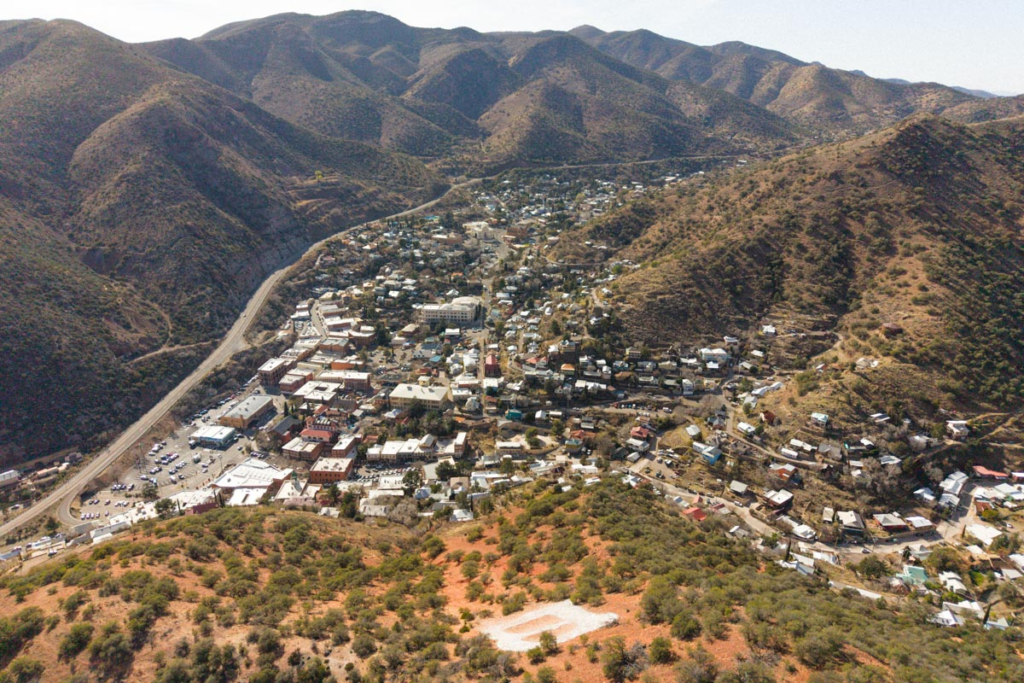
Bisbee does not sprawl. It cannot. The terrain refuses it. Instead, the town has grown upward along the canyon walls in a layered accumulation that resembles nothing so much as a stratigraphic section — each era of prosperity and decline deposited as a visible stratum. The Queen Mine headframe from 1917. The Art Deco Phelps Dodge mercantile. The Victorian timber-frames on Brewery Gulch, tilted at angles that suggest subsidence, dream, or both. And above all of it, the staircases: 3,000 steps of public right-of-way climbing through private gardens, past rusted water tanks, through zones of agave and morning glory, arriving suddenly at a front door, a cat, a view that reorganizes everything below into pure composition.
As a photographer I am responding to a fact about Bisbee that is difficult to articulate but impossible to ignore: the town has already done the work of curation. Entropy and intention have collaborated here across 130 years to produce something that functions like a permanent installation. The peeling Pepsi-Cola ghost sign on Tombstone Canyon (now “restored”). The parade of painted Victorians cascading down School Hill in colors no paint manufacturer would name: rust-amnesia, dried-blood-of-something-hopeful, the green of oxidized longing.
THE ALCHEMICAL FUNCTION – Transformation as Civic Identity
Alchemy was never about gold. It was about transformation as a form of knowledge — the belief that to change a substance was to understand it, that the process of conversion was itself the revelation. Bisbee is the most alchemical community in contemporary America because it has undergone genuine metamorphosis not once but continuously, and has made that metamorphosis the central fact of its identity. Bisbee has mastered the final stage of the Magnum Opus: the transmutation of base metal into social consciousness.
- The Nigredo (Blackening): The era of the deep shafts, the soot-stained faces, and the extraction of 8 billion pounds of copper. A period of subterranean trauma.
- The Albedo (Whitening): The 1970s collapse, where the dust settled and the “hippies” arrived like spores, colonizing the industrial ruins with murals and folk-art totems.
- The Rubedo (Reddening): The current 2026 state—a vibrant, oxidized culture where the rusted machinery of the past has been fused with the digital aesthetics of the future.
The copper was pulled from the earth — 8 billion pounds of it — and sent into the electrical nervous system of the 20th century. The mine closed. The town, rather than dying as the Phelps Dodge Corporation perhaps expected, transmuted. Hippies arrived in the 1970s, drawn by cheap real estate and the particular quality of light that occurs at 5,000 feet in a canyon oriented east-west. Artists followed. Then the photographers arrived to document the artists, and then more artists arrived because the photographers had made the place legible, and then the photographers like myself arrived to document the new legibility. The alchemical cycle accelerated.
What has been produced from this process is something genuinely novel: a community whose primary resource is its own transformed history. Bisbee does not trade in nostalgia, though nostalgia is available. It trades in the ongoing spectacle of a place that continues to mean something — that refuses the settled interpretation, that keeps generating new readings from the same ore body.
THE ANTHROPOCENE SPECIMEN – Why Here, Why Now, Why the Camera Cannot Look Away
The Anthropocene demands a typology of its own monuments. Not the triumphalist monuments of the Holocene — cathedrals, capitals, bridges — but the inadvertent monuments: the places where human activity has so thoroughly inscribed itself upon the physical world that the inscription becomes the landscape. Chernobyl. The Great Pacific Garbage Patch. The Colorado River Delta, running dry. Bisbee’s Lavender Pit.
What distinguishes Bisbee from these other Anthropocene sites is that it is inhabited and inhabited beautifully. The wound has not merely healed over; it has been woven into the local nervous system as a source of meaning rather than shame. The pit is not hidden. It is the first thing pointed out to visitors. It appears in real estate listings as a selling point. Its mineral colors — the mauves and acid greens of oxidizing copper compounds — have influenced the palette of the town’s building stock, as though the earth’s chemistry has upwelled into the chromatic choices of the community living on its rim.
TERMINUS – The Perfect Community and Its Implications
The perfect Anthropocene community would be one that has metabolized its own destructive history into a sustainable source of meaning; that has transformed extraction into expression; that holds past and present in a productive, generative tension rather than resolving that tension through either denial or collapse. It would be small enough to be legible and complex enough to be inexhaustible. It would sit near a border — literal or metaphorical — that keeps it aware of its contingency. It would have stairs.
Bisbee has all of these things. The photographers who return here year after year are not chasing nostalgia or the picturesque, though both are available. They are responding to something more precise: the sensation of being in a place that has already survived its own ending and is now engaged in something for which we do not yet have a proper name — a form of collective intelligence about how to live inside a wound, how to make the scar tissue luminous, how to look directly at what we have done to the earth and find in that confrontation not despair but, astonishingly, beauty.
The camera is the right instrument for this investigation. It is, after all, an extraction device — it pulls light from a scene, fixes it, removes it from the flow of time. In Bisbee, surrounded by the evidence of other extractions, the camera becomes self-aware. The photographer becomes self-aware. The act of making an image here is not separate from the history of the place. It is continuous with it.
To photograph Bisbee today is to capture the Anthropocene in its most honest state. We are no longer looking at nature; we are looking at a landscape that has been thoroughly digested by human hunger and then regurgitated as a beautiful, terrifying artifact.
In this high-desert vacuum, the camera captures the truth of 2026: we are all miners now, sifting through the tailings of the 20th century, looking for a shimmer of gold in the exhausted earth. Bisbee is the blueprint—a terminal beach where the tide of history has gone out, leaving behind a dazzling, calcified reef of human eccentricity.
This is why Bisbee is the perfect alchemical Anthropocene community. Not because it is resolved — it is not — but because it is in process. Still transmuting. Still warm from the reaction.
Further Reading:
To really explore the idea of Bisbee as the prefect Anthropocene community (and see some pretty amazing photographs too) you should check out Virgil Hancock III’s book “Bisbee – The Alchemical City of the Borderlands”. It’s a fascinating read and chock full of beautiful photography including historic photos.
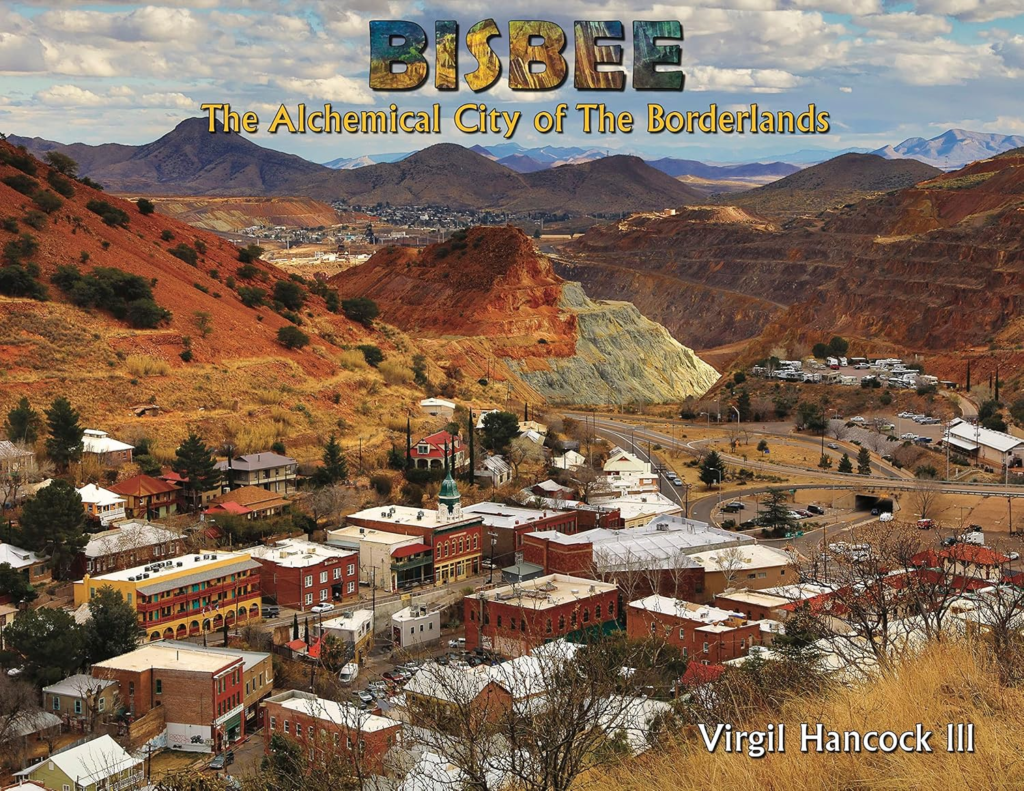
Virgil Hancock III
Bisbee
The Alchemical City of the Borderlands